
A Brain Interface for the Paralyzed
Department:
Brain Science
Teaser:
"A tiny chip implant is enabling paralysed and injured people to move objects by the power of their thoughts -- and, in time, researchers hope it could help them walk again"
Source:
Science news, comment and analysis | guardian.co.uk Download time: Apr 17 2011 8:21 AM ET
The robotic arm clutched a glass and swung it over a series of coloured dots that resembled a Twister gameboard. Behind it, a woman sat entirely immobile in a wheelchair. Slowly, the arm put the glass down, narrowly missing one of the dots. "She's doing that!" exclaims Professor John Donoghue, watching a video of the scene on his office computer – though the woman onscreen had not moved at all. "She actually has the arm under her control," he says, beaming with pride. "We told her to put the glass down on that dot."
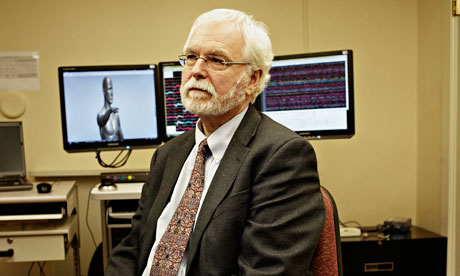
The woman, who is almost completely paralysed, was using Donoghue's groundbreaking technology to control the robot arm using only her thoughts. Called BrainGate, the device is implanted into her brain and hooked up to a computer to which she sends mental commands. The video played on, giving Donoghue, a silver-haired and neatly bearded man of 62, even more reason to feel pleased. The patient was not satisfied with her near miss and the robot arm lifted the glass again. After a brief hover, the arm positioned the glass on the dot.
This is the remarkable world of the brain-computer interface, or BCI, of which BrainGate is one of the leading devices and Donoghue one of its most successful pioneers. It is a branch of science exploring how computers and the human brain can be meshed together. It sounds like science fiction (and can look like it too), but it is motivated by a desire to help chronically injured people. They include those who have lost limbs, people with Lou Gehrig's disease, or those who have been paralysed by severe spinal-cord injuries. But the group of people it might help the most are those whom medicine assumed were beyond all hope: sufferers of "locked-in syndrome".…
User login
Interactive Sky Charts
Best Online Casino